Jul 02, 2026
El Nino Impact on Mato Grosso Soybean Yields
Author: Michael Cordonnier/Soybean & Corn Advisor, Inc.
As El Nino continues to intensify, its potential impact is already being incorporated into estimates for the 2026/27 soybean crop in Mato Grosso, Brazil's largest producing state. In their weekly bulletin, the Mato Grosso Institute of Agricultural Economics (Imea) estimated the state's 2026/27 soybean production at 48.88 million tons, 5.2% lower than 2025/26.
In Brazil, El Nino changes the distribution of rainfall among the producing regions favoring above average precipitation in southern Brazil with increasing irregularity of rainfall in the Midwest, Northern, and Northeastern Brazil. Traditionally, El Nino can result in extended periods of dry weather and water deficits in Mato Grosso and other areas of central Brazil throughout the growing season which can impact not only planting, but also crop development, depending on the intensity and duration of the dry periods.
Farmers in Mato Grosso and other regions of northern Brazil are being advised to diversify their soybean varieties to include more medium and long cycle varieties to mitigate the potential risks of dry weather.
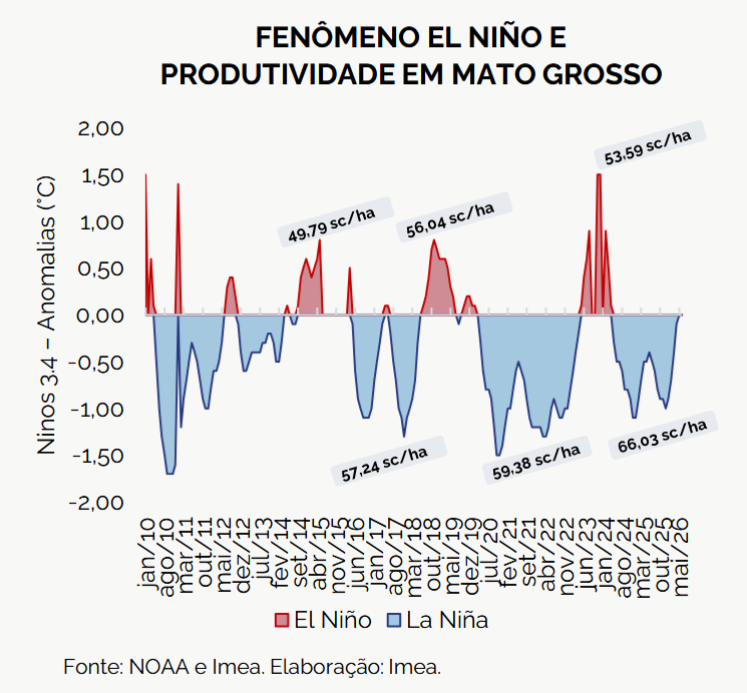
Below is a study conducted by Imea comparing the soybean yields in Mato Grosso during El Nino years (red) and La Nina years (blue) from 2010 to 2026. The average yield during the three El Nino episodes was 53.1 sacks per hectare or 48.5 bu/ac. The average yield during La Nino episodes was 60.8 sacks per hectare or 54.3 bu/ac or 6.8 bushels more than during El Ninos.
If you look at the side-by-side comparison, between 2014 and 2018, yields during El Nino were 6.7 bushels lower, between 2018 and 2023, El Nino yields were 2.9 bushels lower, and between 2024 and 2026, El Nino yields were 11.5 bushels lower.
As mentioned earlier, an El Nino usually results in above normal rainfall in southern Brazil, which can be either positive or negative depending on the amount and timing of the rain. It remains to be seen if lower soybean yields in central Brazil resulting from El Nino can be compensated for by higher yields in southern Brazil. Bottom Line: as El Nino intensifies, odds are increasing that Brazil's 2026/27 soybean production may be disappointing.
Below are the results of a study conducted by Imea comparing soybean yields in Mato Grosso during three recent El Nino episodes (red) and three recent La Nina episodes (blue).